
You walk outside after a hail storm. The yard is a mess. There’s ice in the gutters. But you look up at your roof from the driveway and it looks fine. No missing shingles. No obvious holes. You go back inside and figure you got lucky.
That assumption costs Colorado homeowners thousands of dollars every year.
Most hail damage happens at a scale you cannot see from the ground. Tiny impacts knock loose the protective layer on your shingles. The roof keeps working for a while. Then six months later you have a leak, an aged-out roof, or an insurance claim that gets denied because too much time has passed since the storm.
We’re a local Pueblo roofing contractor. We inspect roofs across Pueblo, Pueblo West, Cañon City, Florence, and the Front Range every week. This guide walks you through exactly what hail damage looks like, what to check from the ground, what only a trained inspector can spot, and what to do next so you don’t end up in that six-months-later mess.
Why hail damage is so hard to spot in Colorado
Asphalt shingles, the most common roofing material in Colorado homes, are protected by a layer of small mineral granules embedded in the surface. Those granules block UV rays from breaking down the asphalt underneath. When hail hits a shingle, the impact knocks granules loose. The shingle still looks mostly intact from a distance, but the protective layer is now compromised at every impact point.
From thirty feet below on your driveway, those impact points are nearly invisible. Damage at the granule level takes either binoculars or a roof walk to detect reliably.
This matters more here than almost anywhere else. The Front Range corridor — Pueblo included — sits inside what the insurance industry calls “Hail Alley,” the stretch of high plains from northern Texas up through eastern Colorado, Wyoming, and Nebraska that racks up the country’s worst catastrophic hail losses. According to the Rocky Mountain Insurance Information Association, Colorado consistently ranks among the top two states in the nation for hail insurance claims, alongside Texas. Hailstorms have caused more than $5 billion in insured damage across the state over the past decade. The 2017 Front Range hailstorm produced $2.3 billion in insured losses by itself and remains Colorado’s most expensive insured catastrophe on record.
In February 2026, the Colorado Division of Insurance released data showing that hail now accounts for between 26 and 54 percent of a Colorado homeowner’s insurance premium, depending on the county. Along the Front Range corridor that includes Pueblo, Pueblo West, Colorado Springs, and the surrounding region, hail accounts for roughly half of what homeowners pay for insurance. The state has formally identified hail as the number one cost driver of homeowner insurance premiums in Colorado.
Translation: hail is the dominant threat to Colorado roofs, and most of the damage it does is invisible from your driveway.
What size hail damages a roof?
Hail doesn’t need to be golf-ball sized to damage a roof. Pea-sized hail can knock granules off aged shingles. Quarter-size hail can damage aged or brittle shingles, and hail from about 1 to 1.5 inches damages most asphalt roofs. Here’s the working chart we use:
| Hail size | Comparison | Damage potential |
| Less than 0.75 inch | Smaller than a dime | Rarely causes functional damage |
| 0.75 to 1 inch | Penny to quarter | Possible damage to aged or brittle shingles |
| 1 to 1.5 inches | Quarter to ping pong ball | Damages most asphalt shingles |
| 1.5 to 1.75 inches | Ping pong ball to golf ball | Significant damage to asphalt, dents metal |
| 1.75 to 2.5 inches | Golf ball to tennis ball | Severe damage, can puncture aged roofs |
| 2.5 inches and larger | Larger than a tennis ball | Catastrophic, punctures most roofing |
Two factors multiply impact force beyond what size alone suggests.
Wind speed. Hail driven by 60 mph wind hits harder than the same size hail falling straight down. A storm with strong wind can cause significant damage from hail that would otherwise be marginal.
Roof age. New, flexible shingles absorb impact better than old, brittle ones. A 15-year-old roof can sustain serious damage from 1-inch hail. A new roof might shrug off 1.25-inch hail with minimal harm.
This is why two homes on the same street can have very different damage outcomes from the same storm.
How to spot hail damage from the ground
Don’t climb your roof. Inspecting from the ground is limited, but it gives you enough to know whether you need to call a professional.
Walk the perimeter of your home and look for these signs of collateral damage:
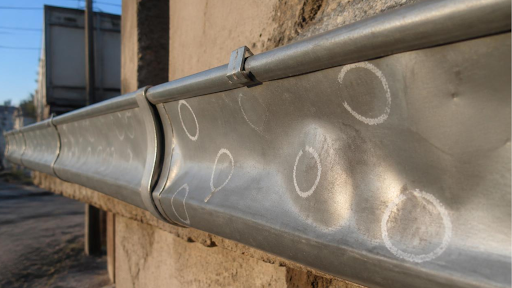
Gutters and downspouts. Aluminum gutters are softer than roofing materials, so they show hail impact clearly. Dents in gutters are often larger than the hailstones that made them, which makes them a reliable indicator that hail fell. Walk the full perimeter and check both the front face and the top edge of the gutters.
AC condenser fins. The cooling fins on your outdoor AC unit are very soft metal. Direct hail hits bend or flatten them. If your AC fins are damaged, your roof almost certainly took hits too.
Vent covers and exhaust hoods. The metal vent covers on the side of your house and any exhaust hoods (for stoves, bathrooms, dryers) show dents from hail impact.
Window screens. Hail can tear or punch holes through window screens. Check the screens on the storm side of the house first.
Aluminum or vinyl siding. Dents in aluminum siding, cracks in vinyl siding. Look across the broad faces, not just the corners.
Painted wood surfaces. Decks, fences, mailbox posts. Hail leaves chips in the paint where it strikes.
Spatter marks. Sometimes called splash marks. When hail hits a weathered surface like a deck rail or concrete walkway, it leaves a clean, dust-free spot. Look for these on horizontal weathered surfaces.
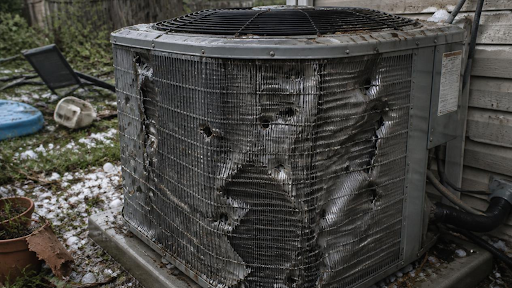
Then check for granule loss and interior signs:
Granule accumulation. Walk to the base of every downspout and to the area of your driveway directly downhill from the gutters. A noticeable pile of small mineral granules washing out after a storm is one of the most reliable signs your shingles took impact. Some granule loss is normal on aging roofs, but a sudden new deposit after a specific storm is a red flag.
Ceiling stains. Check the ceilings in upper rooms, especially after later rain events. New water stains that appeared after the storm date are evidence of active water intrusion.
Attic inspection. If you can safely get into your attic, look for daylight through the roof deck (serious damage) or wet spots on the underside of the roof sheathing.
If you find any of these collateral signs, your roof very likely sustained hail damage even if you can’t see it from the ground. That’s the point where you call a contractor for a free inspection.
What hail damage looks like on different roofing materials
Different roofing materials show hail damage differently. Knowing what to look for on your specific roof matters.
Asphalt shingle hail damage
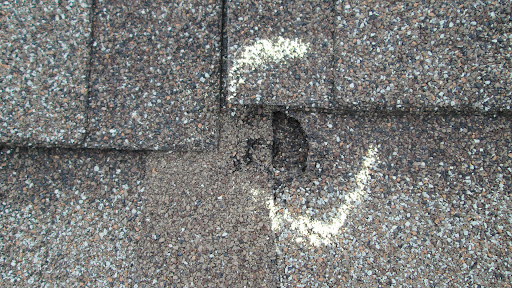
Asphalt shingles are the most common roofing material in Pueblo and across Colorado. Hail damage on asphalt has a specific look that experienced inspectors recognize fast.
Random circular impact marks. True hail damage has no pattern. Impacts are scattered randomly, depending on wind direction and how the storm crossed the home. If you see damage in a clear pattern — lines, paths, repeated shapes — it’s probably not hail.
Granule loss exposing the black mat. Each impact knocks granules loose, exposing the asphalt underneath. Fresh hail damage shows dark spots where the black mat is visible.
Shiny spots. When the asphalt is freshly exposed and not yet weathered, it looks shiny under sunlight. Shiny spots are a strong sign of recent impact.
The “bruise on an apple” test. This is what we mean when a hit feels “spongy.” The impact compresses and fractures the fiberglass mat inside the shingle. Pressed gently, a bruised shingle feels soft, like pressing on a bruised piece of fruit. That’s functional damage, not just cosmetic surface wear.
Mat fracture visible from underneath. When a shingle is lifted during inspection, an indentation on the back confirms the impact fractured the fiberglass mat. It’s one of the clearest signs of hail-caused structural damage.
What hail damage on asphalt is not:
- Blistering. Small raised bumps from manufacturing defects or trapped moisture. Uniform in size, appears in patterns, not random.
- Algae or moss streaks. Dark vertical streaks, usually on north-facing slopes. Biological growth, not impact.
- Normal granule loss. Aged shingles shed granules evenly over time. Uniform thinning is age, not hail.
- Mechanical damage. Scuff patterns following a clear path, often from foot traffic, tree branches, or animals. Not random like hail.
InterNACHI’s professional inspection guide covers these distinctions in technical detail if you want to go deeper.
Metal roof hail damage
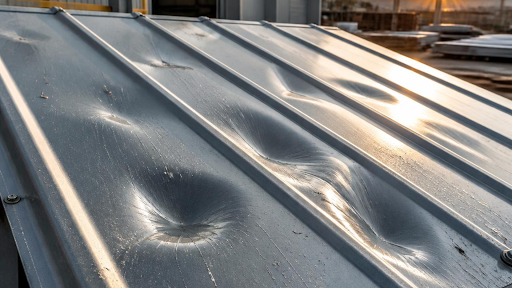
Metal roofs handle hail differently than asphalt. According to InterNACHI’s metal roof inspection reference, hail may dent metal panels but seldom causes functional damage, because the panels are well-supported by the substrate beneath them.
What hail damage on metal roofs typically looks like:
- Dents and dimples in panel flats. Visible from the ground in many cases, especially on standing seam roofs with large flat areas.
- Damage to ridge caps and trim. The ridge cap at the peak and the hip caps take the most direct hits. Damage here is more likely to be functional than damage to the panel flats.
- Punctures are rare. Properly installed 24-gauge metal almost never punctures from hail in Colorado conditions.
The big question on metal roofs is whether the damage is functional or cosmetic. Most carriers treat metal roof dents as cosmetic unless they affect water-shedding ability. We cover this in detail on our metal roofing page, including how cosmetic damage waivers in Colorado policies affect your claim.
Wood shake roof hail damage
Wood shake roofs are less common in the Pueblo market, but they exist, especially in older mountain-style homes. Hail damage on wood shakes:
- Splits along the wood grain. Fresh splits have sharp edges with no weathering.
- Cracked or chipped shake edges. Where the impact removed material from the edge of the shake.
- Random distribution. Like asphalt, real hail damage on wood is scattered, not patterned.
Tile roof hail damage
Tile is uncommon in Southern Colorado but worth covering. The tricky part with hail on tile is that damage is often invisible from below. A direct hit can crack a tile without displacing it. The crack stays in place, the tile keeps holding water out for a while, then at the next significant rain, water begins finding its way through. By the time a leak shows up inside the home, the underlying damage has often spread to the underlayment.
What hail damage looks like up close on the roof (what a pro sees)
We don’t recommend homeowners climb on a roof. The risk is real and the inspection isn’t as useful as what a trained inspector can do. But understanding what your inspector is doing helps you judge the report you get back.
The 10-by-10 test square method
Insurance adjusters and trained roof inspectors use a standardized method. They mark off a 10-foot by 10-foot section of each slope with chalk, then walk that section carefully and mark every functional hail impact.
The point is to give the carrier a quantifiable, repeatable measure of damage that doesn’t depend on visual judgment.
The 8-to-10 hits per 100 square feet threshold
This is the number most Colorado homeowners don’t know. Most carriers approve full roof replacement when an adjuster documents 8 or more functional hail impacts within a single 10-by-10 test square on any side of the roof. Some carriers use 10 as the threshold. A few use lower numbers for certain shingle types.
If your roof has multiple slopes that exceed this threshold, you’re very likely looking at a full replacement, not a repair. If only one slope exceeds it, you may still qualify for full replacement under the “matching” provisions in most policies, because new shingles won’t blend visually with old ones.
Where damage concentrates
Hail damage isn’t evenly distributed across a roof. Inspectors know where to look:
- Storm-facing slopes. Colorado storms generally move west to east, so the west and south sides usually take the worst hits.
- Ridge lines and hip lines. Shingles bent over the ridge are stressed and more vulnerable to fracture.
- Field areas. The broad flat areas of each slope, well-supported but exposed.
- Around penetrations. Vents, pipe boots, and skylights often have soft metal flashing that shows hits clearly even when nearby shingles look fine.
What inspectors photograph
A useful inspection report should include:
- Wide shots of each slope showing overall condition
- Close-ups of representative hail impacts, ideally with a ruler or coin for scale
- Photos of the chalk-marked test squares with hit counts visible
- Collateral damage photos (gutters, AC, vents)
- Date stamps on every photo
If your contractor can’t produce a report at this level, the carrier will have an easier time disputing your claim. Owner-operator Tony Carleo and our crew document at this level on every inspection, because it’s what protects homeowners during the claims process. You can see more about how we handle storm damage roof repair for our clients.
What to do after a hail storm in Colorado
The decisions you make in the first few days after a hail event have a real effect on how the insurance claim resolves. Here’s the step-by-step we walk homeowners through.
First 48 hours
Document everything before you clean anything up.
- Date-stamped photos and videos of all collateral damage (gutters, AC unit, vents, screens, siding, paint, deck, plant leaves)
- Photos of any debris on the ground (broken shingle pieces, granule piles, branches)
- Photos of the inside of the attic if accessible
Check the NOAA Storm Events Database for the date of the storm. It confirms the hail size officially recorded for your area, which is useful documentation for insurance.
Don’t climb the roof yourself. Roof falls are common after storms because surfaces are slick and structural integrity may be compromised.
Don’t accept door-knockers. Storm-chaser crews from out of state flood Colorado neighborhoods within hours of every significant hail event. They show up with branded shirts, ladders on the truck, and pressure-sales tactics. Some are reputable. Many are not. A local Colorado contractor with a permanent address, real reviews, and a real local phone number is a safer choice.
First 7 to 14 days
Schedule a free roof inspection with a local Colorado contractor. Look for a physical address in the Front Range region, not a magnetic sign on a truck from out of state.
Get the inspection before you call your insurance company. Knowing exactly what you have shapes the conversation with your insurer. If your contractor finds significant damage, you file with confidence. If your contractor finds minor damage, you may decide not to file at all.
Get a written inspection report — photos, hit counts per slope, collateral damage documentation, recommendations. If a contractor can’t provide this, find a different contractor.
File the claim if damage is documented. You have a right to file. The Colorado Division of Insurance maintains consumer resources on storm damage claims that explain your rights as a policyholder.
When the adjuster arrives
Have your contractor present at the adjuster meeting. This is standard practice in Colorado restoration work. We send someone to walk the roof alongside your adjuster, agree on the scope of damage, and produce a documented estimate — so nothing gets missed. This is where help with your insurance claim makes the biggest difference.
Bring your inspection report and photos. Even if the adjuster is doing their own count, your documentation backs up the conversation.
Understand the adjuster’s role. Insurance adjusters work for the insurance company, not for you. They’re usually fair, but their job is to settle the claim accurately for the carrier, which sometimes means underestimating damage. Your contractor’s job is to make sure damage isn’t missed.
If the claim is denied, you have options. You can request a re-inspection, dispute the finding with supplemental documentation, request a different adjuster, or use the appraisal clause in your policy to bring in an independent third party. A denied claim isn’t necessarily a final answer.
Timeline pressure
Colorado law allows time to file a hail damage claim, but the practical reality is that the longer you wait, the harder it becomes to prove the damage came from a specific storm. The adjuster can reasonably argue that some of it could be from a later storm or normal wear.
Aim to have your inspection done within 30 days of the storm and file the claim within 60 days. These aren’t legal deadlines, just the practical window where carriers are most receptive.
The 2026 mitigation incentive
In June 2026, Colorado signed SB26-155 into law, creating the Strengthen Colorado Homes Enterprise to fund grants for homeowners who fortify their roofs with impact-resistant materials. The program is still being set up — the state is assembling the board that will run it, and grants are not open yet. But if you’re replacing your roof anyway, it’s worth watching: upgrading to impact-resistant shingles or a metal roof may qualify for state assistance once the program launches. Check the Colorado Division of Insurance website for the current status.
The Insurance Institute for Business and Home Safety (IBHS) maintains the technical standards behind impact-resistant ratings and is a useful resource if you want to understand what makes a roof more hail-resilient before you choose a replacement.
When to call a contractor for a free inspection
A free roof inspection is the right call in any of these situations:
- After any hailstorm with hail 1 inch or larger in your area
- After any storm where you see collateral damage (dented gutters, damaged AC fins, torn screens)
- When you find granule accumulation at downspouts or on the driveway after a storm
- Once a year after spring and summer storm season, as preventive maintenance
- Before listing your home for sale (a clean inspection report supports a stronger asking price)
- After hearing that a storm hit your area even if you weren’t home to see it
There’s no cost or obligation. The inspection is information. What you do with it is up to you.
Frequently asked questions
What does hail damage look like on an asphalt shingle roof? Hail damage on asphalt shingles appears as random circular impact marks where granules have been knocked loose, exposing the black asphalt mat underneath. Fresh damage may look shiny. Bruised shingles feel soft or spongy when pressed, like pressing on a bruised apple. The damage has no pattern; impacts are scattered randomly across the surface.
What size hail damages a roof? Hail around 1 to 1.5 inches — from quarter to ping-pong-ball size — damages most asphalt shingle roofs. Quarter-size hail (about 1 inch) can damage aged or brittle shingles, and anything larger than 1.5 inches damages even newer shingles and starts to dent metal. Wind-driven hail hits harder than hail falling straight down, so a storm with high winds can cause significant damage from smaller hail.
Can you see hail damage from the ground? Usually not on the shingles themselves, because the damage happens at the granule level and is invisible from a distance. But you can see collateral damage from the ground: dented gutters, bent AC condenser fins, torn window screens, damaged vent covers, granule piles at downspouts. Collateral damage almost always means the roof took hits too.
How long after a hail storm can you file a claim in Colorado? Colorado law allows time to file, but as a practical matter, aim to have an inspection done within 30 days and file the claim within 60 days. Waiting longer makes it harder to prove the damage came from a specific storm rather than later weather or normal wear.
How many hail hits does it take for insurance to replace a roof? Most Colorado carriers approve full roof replacement when an adjuster documents 8 or more functional hail impacts within a single 10-by-10-foot test square on any side of the roof. Some carriers use 10 as the threshold. If multiple slopes exceed the threshold, full replacement is very likely.
Does insurance cover hail damage to roofs in Colorado? Yes. Standard Colorado homeowner policies cover sudden hail damage to roofs, subject to your deductible. Some policies have cosmetic damage waivers (more common on metal roofs) that exclude purely cosmetic dents. Roofs older than 10 to 15 years may be covered on an actual cash value basis rather than replacement cost, which affects how much the insurer pays.
What if my insurance company denies my hail damage claim? You have options. You can request a re-inspection, submit supplemental documentation from a qualified contractor, request a different adjuster, or invoke the appraisal clause in your policy for independent third-party review. A denied claim isn’t necessarily the final answer, especially when the original inspection missed documented damage.
How much does a hail damage roof inspection cost? Reputable local Colorado contractors offer free hail damage roof inspections. There should be no charge and no obligation. If a contractor asks for payment before performing the inspection, find a different contractor.
Will hail damage cause a leak? Not immediately, in most cases. Hail damage usually doesn’t cause a leak the day of the storm. Instead, the granule loss accelerates UV degradation of the shingle, which leads to cracks, brittleness, and eventually leaks months or years later. That delayed damage is why catching hail damage early matters so much.
Can hail damage a metal roof? Yes, but the damage is usually cosmetic rather than functional. Hail can dent metal panels, especially on standing seam roofs with large flat areas. Properly installed 24-gauge metal almost never punctures from Colorado hail. We cover this in detail on our metal roofing page.
How can I tell hail damage from normal wear and tear? Pattern is the key. Hail damage is randomly scattered with no pattern, because impacts depend on wind direction and storm angle. Normal wear, blistering, algae, and mechanical damage all have some kind of pattern: uniform thinning, vertical streaks, raised bumps in lines, scuff paths from foot traffic. If the damage is random and the impacts are circular, hail is the likely cause.
The bottom line
Hail damage is the most common and most misunderstood roof problem Colorado homeowners face. It’s hard to see, easy to ignore, and expensive to deal with later. The homeowners who get the best outcomes are the ones who catch it early, document it well, and work with a local Colorado contractor who knows how to handle the insurance side.
If you’ve had any significant hail in your area in the last 30 days, get an inspection. If your gutters are dented or your AC unit looks beat up, get an inspection. If you see granules piling up at your downspouts, get an inspection.
We offer free roof inspections across Pueblo, Pueblo West, Cañon City, Florence, Colorado Springs, and the surrounding Front Range communities. We document everything, we work directly with your insurance company if a claim is warranted, and we give you a straight answer either way.
Your Roof, Our Honor isn’t a slogan to us. It means we show up on time, document every slope, and stand with you through the claim instead of just filing paperwork and hoping. Call us at (719) 716-ROOF or request a free, no-obligation inspection.
We’re based at 503 N Main St in downtown Pueblo — roofing contractors in Pueblo, CO you can actually find. Not an out-of-state storm chaser, not a national franchise. A local contractor that handles Colorado hail damage every week and will still be here next year if you need us.
You can read more about how we handle residential roofing and storm damage restoration for Colorado homeowners.
Patriot Roofing is a locally owned roofing contractor based at 503 N Main St #611, Pueblo, CO 81003. We specialize in insurance claim restoration, hail and storm damage repair, and residential roof replacement across Pueblo, Pueblo West, Colorado Springs, Cañon City, Florence, and the broader Southern Colorado region.