
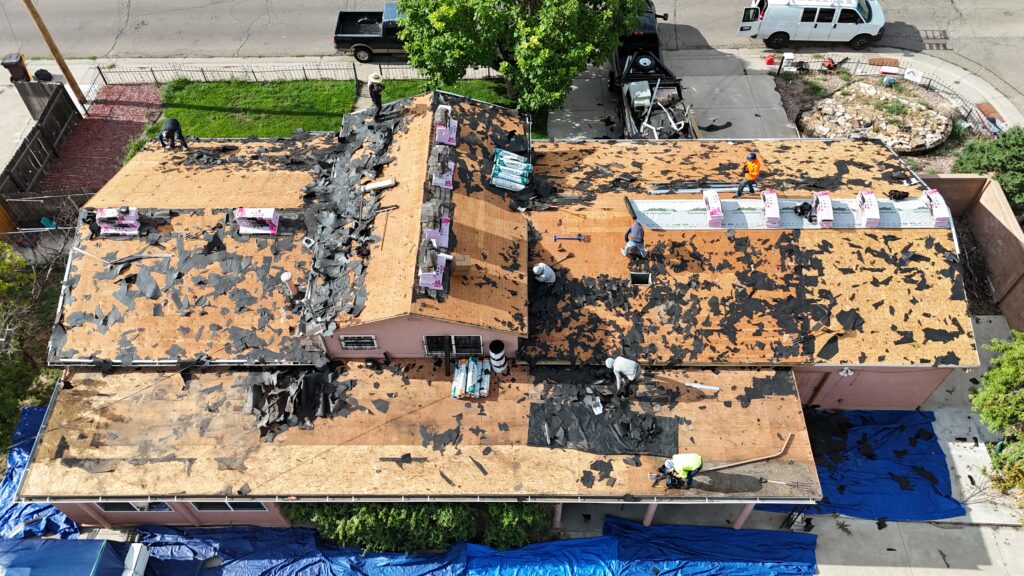
If you live anywhere along Colorado’s Front Range, you have probably watched your asphalt shingle roof take a beating from hail more than once. Maybe more than once this year. And if you have been through an insurance claim or two, the question eventually comes up: should we just put a metal roof on this thing?
It is a fair question. It is also one that almost nobody answers honestly, because most of what you find online comes from metal manufacturers selling a product or national content sites copying each other.
We are a local Pueblo roofing contractor. We install both asphalt and metal roofs every week across Southern Colorado, and we handle a lot of insurance claims. Here is the honest, Colorado-specific answer to whether a metal roof is worth it, what it actually costs, how it holds up to hail, and what your insurance will and will not cover.
Why this question matters more in Colorado than almost anywhere else
Colorado sits inside the region the insurance industry calls Hail Alley. This corridor runs from northern Texas up through eastern Colorado, Wyoming, and Nebraska, and it produces more severe hailstorms than anywhere else in the country.
According to the Rocky Mountain Insurance Information Association, Colorado has consistently ranked among the top states in the country for catastrophic hail losses. The Front Range corridor from Fort Collins down through Pueblo sees significant hail events almost every season, with the heaviest activity typically falling between April and September.
For homeowners in Pueblo, Pueblo West, Cañon City, and the broader Southern Colorado region, the practical implication is simple. You will deal with hail. Probably more than once. So the choice of roofing material is not just a cost or aesthetic decision. It is a functional decision about which material can take the most punishment over the longest period of time.
That reality is why metal roofs come up in conversation here more than they do in most of the country.
What hail actually does to a metal roof vs an asphalt shingle roof
This is the core of the comparison, so let us be specific about it.
Asphalt shingles in a hail storm
Asphalt shingles are made of a fiberglass mat coated in asphalt and then surfaced with ceramic granules. When hail hits a shingle, it does damage in three ways:
- Granule loss. The impact knocks loose the granules that protect the asphalt underneath from UV. Granule loss accelerates the aging of the shingle.
- Bruising and fracturing. Larger hail can fracture the fiberglass mat under the surface. Bruised shingles look fine from the ground but fail an inspection and shorten roof life.
- Punctures and tears. Very large hail or hail with high impact velocity can puncture all the way through.
Once a shingle roof takes a serious hail hit, the damage is usually cumulative and irreversible. The roof keeps working for a while, but the clock is ticking.
Metal roofs in a hail storm
Metal roofs behave very differently. Most metal roofing installed today is 24 or 26 gauge steel, with a coated finish (typically Kynar 500 or similar). When hail strikes a metal roof:
- Dents are common. Larger hail, especially anything over 1.5 inches in diameter, can leave visible dimples or dents in metal panels. Standing seam panels are more dent-prone than stone-coated steel because they have larger flat areas.
- Punctures are extremely rare. It takes very large, high-velocity hail to puncture metal roofing. In our experience installing roofs across Southern Colorado, we almost never see hail that punctures properly installed metal.
- Functional integrity stays intact. Even when a metal roof gets dented, it almost always continues to perform its job of keeping water out. Most hail damage to metal is what the industry calls cosmetic damage.
That distinction between functional damage and cosmetic damage is important, and we will come back to it when we talk about insurance.
For a detailed visual breakdown of how hail damage presents on different roof types, the International Association of Certified Home Inspectors (InterNACHI) has a thorough technical reference.
How metal roof impact resistance is tested
When you see a metal roof advertised as Class 4 impact resistant, that rating comes from one of two industry tests.
UL 2218
UL 2218 is the standard most people see referenced. It rates roofing materials Class 1 through Class 4 based on impact resistance. Class 4 is the highest rating. To earn it, a roofing material has to withstand the impact of a 2-inch diameter steel ball dropped from 20 feet without cracking, splitting, or tearing.
Most steel and aluminum roofing meets or exceeds Class 4 ratings.
FM 4473
FM Global’s FM 4473 is a similar standard used primarily for commercial applications. It uses simulated hail, which is closer to real-world conditions than a steel ball, and rates products at increasing hailstone diameters.
Both standards matter because they are what most insurance companies recognize when they offer discounts on premiums for impact-resistant roofing.
The real Colorado comparison: metal vs Class 4 impact resistant shingles
Most articles about metal roofs compare them to standard asphalt shingles. In Colorado, that is not the right comparison. The smarter homeowner question here is: should I install a metal roof, or should I install Class 4 impact resistant shingles?
Class 4 shingles, like the GAF Timberline AS II or Owens Corning Duration STORM, use polymer-modified asphalt and SBS (styrene-butadiene-styrene) rubber additives that make the shingle more flexible and impact-resistant than a standard 3-tab or architectural shingle. They are designed specifically for hail-prone regions.
Here is how the two compare on the factors Colorado homeowners actually care about:
| Factor | Class 4 Asphalt Shingles | Metal Roof |
|---|---|---|
| Hail resistance | Excellent (rated impact resistant, may still show granule loss) | Excellent (may dent, almost never punctures) |
| Lifespan | 25 to 30 years typical | 40 to 70 years typical |
| Installed cost (Colorado) | About 25 to 50 percent more than standard shingles | 2 to 3 times the cost of standard shingles |
| Insurance premium discount | Yes, with most CO carriers | Yes, with most CO carriers |
| Weight | Standard | Lighter than asphalt |
| Snow shedding | Standard | Better |
| Fire resistance | Class A | Class A (non-combustible) |
| Resale value | Modest improvement | Stronger improvement, especially in hail-prone markets |
| Repair after damage | Easier to spot-repair | Harder to spot-repair without visible patching |
If your priority is the lowest total cost over 10 to 15 years, Class 4 shingles are often the smarter choice. If you plan to stay in the home for 20 or more years, or you are tired of dealing with insurance claims every few years, metal usually wins on lifetime value.
Metal roof cost in Colorado: what homeowners actually pay
Most articles about metal roof cost give you a national range and stop there. We are going to give you something more useful: what we actually see homeowners pay across the Pueblo and Front Range markets.
Cost per square foot installed
For a typical residential home in Southern Colorado, installed metal roof pricing usually falls into these ranges:
- Exposed fastener metal panels (R-Panel, AG-style): roughly $7 to $11 per square foot installed
- Standing seam metal (24 gauge): roughly $11 to $17 per square foot installed
- Stone-coated steel: roughly $12 to $18 per square foot installed
For comparison, standard architectural asphalt shingles in Colorado typically run $4.50 to $7.00 per square foot installed, and Class 4 impact resistant shingles run $5.50 to $9.00 per square foot installed.
Total cost for a typical Colorado home
A 2,400 square foot home with a moderately complex roof might have around 28 to 32 roofing squares (a square is 100 square feet of roof area). Working through the math:
- Architectural asphalt: roughly $13,000 to $20,000
- Class 4 impact resistant shingles: roughly $16,000 to $26,000
- Standing seam metal: roughly $32,000 to $50,000
- Stone-coated steel: roughly $34,000 to $55,000
These are real ranges based on what we see and bid in our market. Actual cost depends on roof pitch, complexity, tear-off requirements, deck condition, panel profile, color, and whether you need additional work like new gutters or chimney flashing.
What changes the price
If you are getting quotes from multiple contractors, the things that drive the most variation are:
- Gauge of the metal. 26 gauge is lighter and cheaper than 24 gauge. For Colorado hail, 24 gauge is the better choice in most cases.
- Panel profile. Standing seam costs more than exposed fastener.
- Roof complexity. Hips, valleys, dormers, and chimney penetrations all add labor.
- Tear-off scope. Removing one layer of asphalt is standard. Removing two layers, or repairing rotted decking, adds cost.
- Underlayment. Synthetic underlayment is standard. High-temp ice and water shield in valleys and at eaves adds material cost but extends roof life.
Will my insurance pay for a metal roof after hail damage?
This is where most homeowners get tripped up, and it is also where Patriot Roofing does some of our most detailed work. We specialize in insurance claim restoration, so we walk this path with homeowners constantly. Here is what you need to know.
The cosmetic damage waiver
Most Colorado homeowner policies cover hail damage to your roof. But if you install a metal roof, watch for a clause called a cosmetic damage waiver or matching limitation endorsement.
A cosmetic damage waiver says that if hail dents your metal roof but does not affect its function (does not cause leaks or compromise the roofing system), the insurance company will not pay to replace the dented panels. The roof is still doing its job, so they argue there is no covered loss.
This catches a lot of homeowners by surprise. They installed a metal roof partly to deal with hail, then a major storm dents it, and their insurance company will not pay to fix the appearance.
If you are considering metal, ask your agent specifically: does my policy include a cosmetic damage exclusion for metal roofing? If it does, ask what the cost would be to remove it.
Impact resistant roof discounts
The flip side of this is that most Colorado insurance carriers do offer premium discounts for impact resistant roofing, including both Class 4 shingles and metal. Discounts typically range from about 5 percent to 30 percent on the wind and hail portion of your premium, depending on the carrier.
The Colorado Division of Insurance maintains consumer information about hail damage claims and insurance options in our state.
What we see on real claims
When a homeowner with a metal roof has a hail event in Pueblo or anywhere along the Front Range, the claim usually goes one of three ways:
- Function is fine, policy has cosmetic exclusion. Insurance pays nothing. Homeowner lives with the dents.
- Function is fine, policy has no cosmetic exclusion. Insurance pays for panel replacement. This is the best case.
- Function is compromised (water intrusion, panel separation, fastener failure). Insurance pays for repair or replacement under standard hail damage coverage regardless of cosmetic clauses.
If you are unsure how your claim is being handled, you can call us for a free roof inspection and we will help you understand what your policy actually covers.
We cover this process in more detail on our storm damage roof repair page.
The Colorado snow question
Hail gets most of the attention, but Colorado winters bring their own roofing challenges. Pueblo gets less snow than the higher elevations, but Cañon City, Florence, and especially anything closer to the foothills can see substantial snow loads.
How metal roofs handle snow
Metal roofs shed snow better than asphalt. The slick surface and lower friction coefficient mean snow tends to slide off rather than build up. This is mostly a benefit:
- Less snow load sitting on the roof
- Less risk of ice dams at the eaves
- Less moisture sitting against shingles and degrading them
But it also means you need to plan for where the snow goes when it slides off. Above doorways, walkways, gas meters, and parked cars are all places where falling snow from a metal roof can cause problems.
Snow guards
The fix is snow guards, also called snow retention devices. These are small metal brackets installed at the eave that hold snow in place until it melts gradually rather than sliding all at once.
If you install a metal roof on a Colorado home with any roof surface above a high-traffic area, snow guards are not optional. They should be part of the install scope from day one.
Ice dam performance
Metal roofs do better with ice dams than asphalt, but they are not immune. Proper attic insulation and ventilation matter just as much with metal as with asphalt. A poorly insulated attic will cause ice dams on any roof.
Common metal roof concerns answered
These are the questions we get from Colorado homeowners considering metal, with straight answers.
Are metal roofs noisy in rain and hail?
This is the most persistent metal roof myth. Modern metal roofs installed over solid decking and underlayment are not meaningfully louder than asphalt shingles. The metal roofs that earned this reputation are the ones installed over open purlins on barns and sheds, with nothing to dampen sound. A residential metal roof on a properly insulated home sounds essentially the same as a shingle roof from inside.
Do metal roofs leak?
A properly installed metal roof is one of the most leak-resistant roofs you can buy. Leaks on metal roofs almost always trace back to installation errors, particularly at penetrations (vents, chimneys, skylights) or at panel terminations. The quality of the install matters more than the quality of the panel.
Can you walk on a metal roof?
Yes, with care. Standing seam metal roofs should be walked in the flat areas between the seams, with soft-soled shoes, and ideally only by trained roofers or service technicians. Stone-coated steel is more forgiving and can generally be walked anywhere with appropriate footwear. Either way, you do not want HVAC technicians, satellite installers, or anyone else walking on your roof without training.
Do metal roofs attract lightning?
No. This is one of the most common myths and it is straightforwardly false. Metal roofs do not increase the likelihood of a lightning strike. If anything, because metal is non-combustible, metal roofs are safer in a lightning event than asphalt, which can catch fire.
How long does a metal roof actually last?
In Colorado conditions, a 24 gauge standing seam metal roof installed properly should last 50 to 70 years. Stone-coated steel similarly lasts 40 to 50-plus years. Compare that to architectural asphalt at 25 to 30 years and Class 4 impact resistant shingles at 25 to 30 years, and the lifespan advantage is substantial.
The Metal Roofing Alliance maintains industry data on metal roof performance and longevity if you want to dig deeper.
Will a metal roof affect my home’s resale value?
In hail-prone Colorado markets, yes, almost always positively. Buyers know what hail does to roofs here. A metal roof is a major selling point, especially for buyers who have been through claims on previous homes.
When a metal roof is actually the right call (and when it isn’t)
Honest take from someone who installs both.
A metal roof is probably right for you if:
- You plan to stay in your home 20 or more years
- You are tired of dealing with hail damage claims every few years
- You have a simple to moderately complex roof (extreme complexity drives metal costs up fast)
- You value the lower lifetime cost over the lower upfront cost
- You like the look of metal (style is a personal call)
- You have a wildfire risk concern (metal is non-combustible)
- You want better snow shedding
A metal roof is probably not the right call if:
- You plan to sell within 5 to 10 years and will not recover the cost
- Your budget will be stretched by the upfront price, and Class 4 shingles would deliver most of the hail benefit at half the cost
- Your policy has a cosmetic damage exclusion and you are not willing to absorb that risk
- Your roof has extreme complexity (lots of hips, valleys, and penetrations) where metal labor costs explode
For homeowners in the second category, Class 4 impact resistant shingles are often the smarter choice. We install those constantly across the Pueblo market and they perform well.
What to look for in a Colorado metal roof contractor
If you decide a metal roof is the right call, the install matters more than the panel. Here is what to look for.
Local experience with Colorado conditions. Metal roofing in a humid Southern state is a different job than metal roofing in our climate. UV exposure, temperature swings, snow loads, and our specific hail patterns all matter. Look for a contractor with significant local install history.
Manufacturer certifications. Major panel manufacturers run installer training programs. A certified installer signals real product knowledge.
Detailed scope of work. Your bid should specify gauge, panel profile, color, underlayment type, fastener type, snow guard plan, and warranty terms. Vague bids are a red flag.
Honest insurance handling. If your roof is being replaced under an insurance claim, you want a contractor who works with adjusters directly and communicates clearly. We do this every week and can walk you through the entire process. You can read more about our approach on our residential roofing page.
Real local presence. A storm chaser from out of state, knocking doors after a hail event, is not the same as a contractor with a permanent local office, a real phone number, and reviews from neighbors. We are located at 503 N Main St in downtown Pueblo and have been serving the Front Range for years.
Frequently asked questions
Can hail damage a metal roof? Yes, but the damage is usually cosmetic dents rather than functional failure. Properly installed 24 gauge metal almost never punctures from hail in Colorado conditions. The roof keeps doing its job, but you may see visible dimples after a major storm.
Does insurance cover hail damage on metal roofs? It depends on your policy. Most Colorado policies cover functional damage. Many policies now include a cosmetic damage waiver that excludes dents that do not affect roof performance. Ask your agent specifically about cosmetic exclusions before installing metal.
How much does a metal roof cost in Colorado? Standing seam metal typically runs $11 to $17 per square foot installed. A 2,400 square foot home will usually fall in the $32,000 to $50,000 range. Stone-coated steel runs slightly higher. Exposed fastener panels run lower.
Are metal roofs worth it in Colorado? For long-term homeowners in hail-prone areas, usually yes. The combination of longer lifespan, better hail performance, lower maintenance, and insurance discounts adds up. For homeowners planning to sell within 5 to 10 years, Class 4 impact resistant shingles often deliver better value.
Do metal roofs leak? A properly installed metal roof is one of the most leak-resistant roofs available. Leaks almost always come from installation errors at penetrations, not from the panels themselves.
Are metal roofs noisier than shingles? No, not on a properly built residential roof. The noise myth comes from metal roofs installed over open purlins (barns and sheds) without decking or insulation underneath. A residential install sounds essentially identical to asphalt.
Can you walk on a metal roof? Yes, with the right footwear and technique. Standing seam panels should be walked in the flat areas. Stone-coated steel is more forgiving. In general, leave roof walking to trained professionals.
How long does a metal roof last? Standing seam metal typically lasts 50 to 70 years in Colorado. Stone-coated steel typically lasts 40 to 50 years. Both significantly outlast asphalt shingles, which last 25 to 30 years even in the higher-grade Class 4 versions.
Do metal roofs attract lightning? No. This is a myth. Metal roofs do not increase lightning strike risk, and because metal is non-combustible, they are actually safer than asphalt during a lightning event.
The bottom line for Colorado homeowners
A metal roof is a good investment in Colorado if you plan to stay in your home long enough to amortize the upfront cost, if you are tired of cyclical hail claims, and if you read your insurance policy carefully so you understand how cosmetic damage will be handled.
For most homeowners who want excellent hail performance without the bigger upfront investment, Class 4 impact resistant shingles are the practical middle ground. They cost less than metal, qualify for the same insurance discounts in most cases, and perform very well against Colorado hail.
Either way, the most important factor is the contractor who installs it. A premium panel installed poorly will fail. A standard panel installed by a careful, experienced local contractor will last decades.
If you are weighing this decision and want a straight answer about your specific roof, we offer free roof inspections across Pueblo, Pueblo West, Cañon City, Florence, and the surrounding area. We will walk your roof, look at your current condition, review your insurance policy with you, and give you honest options. No pressure, no high-sales-tactic appointment.
Call us at (719) 716-7663 or request a free inspection here. Whether you end up with metal, Class 4 shingles, or standard architectural shingles, we will help you make the right call for your home and your budget.
Patriot Roofing is a locally owned roofing contractor based at 503 N Main St #611, Pueblo, CO 81003. We specialize in insurance claim restoration, hail and storm damage repair, and residential roof replacement across Pueblo, Pueblo West, Colorado Springs, Cañon City, Florence, and the broader Southern Colorado region.