



Asphalt vs Metal Roof in Colorado Hail Country
If you live anywhere along the Front Range or in Southern Colorado, you live in hail country. So the asphalt-versus-metal question here is not really about looks or lifespan alone. It is about how each roof handles hail, what your insurance will and will not cover, and which one actually costs less over the decades you own the home.
We are Patriot Roofing, based at 503 N Main St in Pueblo, and we install both. This guide gives you the honest comparison, including the parts the brochures skip, like cosmetic damage exclusions on metal and the break-even math most homeowners never run. This is general information and not insurance advice, so confirm coverage details with your agent.
The short version
Asphalt shingles cost less up front, are easy to repair, and when you choose an impact-resistant version they hold up well to hail. Metal roofs last far longer and shrug off hail functionally, but hail can dent them cosmetically, and that is where insurance gets complicated. Here is the side-by-side.
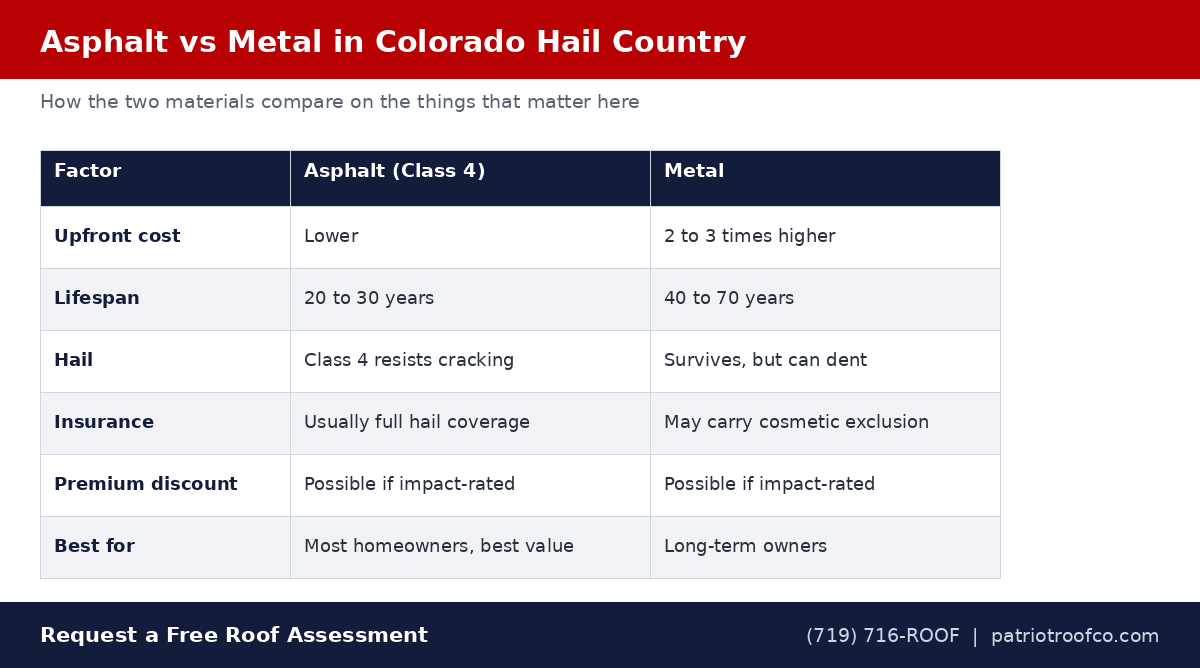
How each one handles Colorado hail
This is the question that matters most here. Hail is the top driver of roofing claims in Colorado, and the two materials fail in very different ways.
Asphalt shingles can crack, bruise, or lose granules when hail hits. Standard architectural shingles take damage in a serious storm. But impact-resistant shingles rated Class 4 are built to survive it. Class 4 is the top rating in the UL 2218 test, where a two-inch steel ball is dropped from 20 feet and the shingle must not crack or split. GAF’s overview of Class 4 shingles explains that the test allows surface dents but not structural cracks. For a lot of Colorado homeowners, a Class 4 asphalt roof is the sweet spot of hail protection and price. Polymer-modified options like Malarkey’s Class 4 Vista shingle are built with a rubberized asphalt that stays flexible and absorbs impact rather than cracking.
Metal roofs almost never fail functionally from hail. The panels keep shedding water even after a bad storm. What they do is dent. Large hail leaves dimples in the metal, and while those dents usually do not affect how the roof works, they change how it looks. That cosmetic difference is exactly what creates the insurance wrinkle below.
The cosmetic damage catch on metal
Here is the part that surprises people. Because metal roofs survive hail functionally, many insurers in hail-prone states like Colorado attach a cosmetic damage exclusion to policies that cover them. That endorsement means the insurer will not pay to replace a metal roof that is only dented, as long as the dents do not affect its function.
The trade-off cuts both ways. A cosmetic damage exclusion often comes with a lower premium, because the insurer is taking on less risk. But it also means that after a big hailstorm, you could be looking at a dented roof that your policy will not pay to replace, even though an asphalt roof next door might be fully covered. Whether that trade works for you depends on how much the appearance matters and how you feel about the premium savings. This is a conversation to have with your agent before you choose a material, not after.
For asphalt, the claim path is more familiar. If hail damages the shingles, it is usually a covered claim, subject to your deductible. Our guides on what hail damage looks like on a roof, how to file a hail damage insurance claim, and how the roof insurance deductible works in Colorado walk through that process.
Insurance premiums and the Class 4 discount
Your choice of roof can also change what you pay every year. Many Colorado insurers offer a premium discount for impact-resistant roofing, because a roof that survives hail files fewer claims. Owens Corning notes these discounts sometimes run in the range of 5 to 30 percent, though the amount varies by carrier and is never guaranteed.
That matters because hail is a huge share of what you pay. The Colorado Division of Insurance reports that hail drives an average of 26 to 54 percent of a homeowner’s annual premium. Both Class 4 asphalt and metal can qualify for impact-resistant discounts, so ask your agent what each would save you. The state is also building new support for resilient roofs through SB26-155, a 2026 law that created a grant program to help homeowners reinforce roofs against hail. Program details are still being finalized, so watch for updates.
The break-even math
Up front, metal costs more. A metal roof commonly runs two to three times the price of an asphalt roof. The case for metal is that it lasts two to three times as long, often 40 to 70 years against roughly 20 to 30 for asphalt, so you may never replace it again.
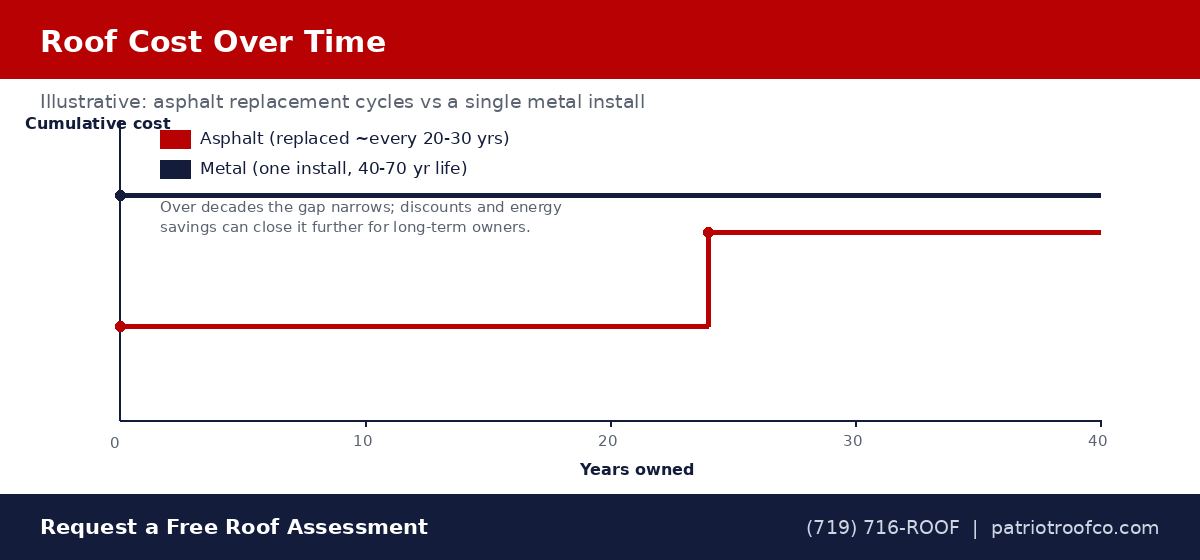
Run it over 40 years and the picture evens out. An asphalt roof might be replaced once or twice in that window, while a metal roof is installed once. Add possible premium discounts and metal’s energy savings from reflecting summer heat, and a long-term owner can come close to break-even or better. But the math flips if you plan to move in ten years, or if a cosmetic damage exclusion means you could still be paying for hail dents out of pocket. In that case, a Class 4 asphalt shingle roof often delivers the better value.
Which should you choose
There is no single right answer, only the right answer for your situation. Metal makes the strongest case for homeowners staying put for decades who want the longest life and do not mind dents, or who choose premium panels and accept the insurance terms. Impact-resistant asphalt makes the strongest case for most everyone else: strong hail protection, full replacement coverage on a standard claim, a possible premium discount, and a far lower price to get there.
Talk It Through Before You Commit
The best way to choose is with someone who installs both and has no reason to push you one way. We will look at your home, your budget, and your insurance situation, and give you a straight recommendation.
Request a Free Roof Assessment today by calling Patriot Roofing at (719) 716-ROOF, or reach us through our contact page. We install asphalt shingle roofing and metal roofing across Pueblo, Colorado Springs, and the Colorado Front Range.
A quick note on upgrading after a storm
A lot of material switches happen right after hail, when a roof needs replacing anyway. If that is you, it is a good moment to weigh Class 4 asphalt or metal instead of rebuilding the same standard roof. Premium shingles of the kind GAF describes in its Timberline UHDZ line show how far impact-resistant options have come. Start with storm damage roof repair or, if you want to get ahead of next season, how to prepare your roof for Colorado hail season.
Frequently Asked Questions
Is a metal roof better than asphalt for hail in Colorado?
Metal survives hail functionally and rarely leaks after a storm, but it can dent cosmetically. Impact-resistant Class 4 asphalt resists cracking and is usually fully covered on a hail claim. The better choice depends on your budget, how long you will stay, and your insurance terms.
Do insurance companies cover hail damage to metal roofs?
Not always. Many Colorado insurers attach a cosmetic damage exclusion to metal roof policies, meaning dents that do not affect function are not covered. That often lowers your premium but can leave you paying for dent repairs. Confirm the terms with your agent before choosing metal.
What is a cosmetic damage exclusion?
It is a policy endorsement that excludes coverage for damage that changes a roof’s appearance but not its function, such as hail dents in metal panels. It usually reduces the premium but shifts the cost of cosmetic repairs to the homeowner.
Are Class 4 asphalt shingles as good as metal against hail?
For hail protection, Class 4 asphalt performs very well. It passes the UL 2218 test, where a two-inch steel ball is dropped from 20 feet without cracking the shingle. It costs far less than metal and is typically covered in full on a standard hail claim.
How much does a metal roof cost compared to asphalt?
A metal roof commonly costs two to three times as much as an asphalt roof up front. The offset is lifespan: metal often lasts 40 to 70 years versus 20 to 30 for asphalt, so you may avoid a future replacement. Exact pricing depends on your home and the panel type.
Can I get an insurance discount for an impact-resistant roof?
Often, yes. Many Colorado insurers offer a premium discount for Class 4 impact-resistant roofs, sometimes in the 5 to 30 percent range, though it varies by carrier and is not guaranteed. Both Class 4 asphalt and metal can qualify, so ask your agent.
Does a metal roof lower my homeowners insurance?
It can, especially if it is impact-rated, but a cosmetic damage exclusion may be part of the deal. The net effect on your premium depends on the carrier and the policy terms, so compare quotes with and without the exclusion.
How long does each roof type last in Colorado?
Asphalt shingles generally last about 20 to 30 years here, and impact-resistant versions tend to hold up better to hail. Metal roofs commonly last 40 to 70 years. Colorado’s sun, wind, and hail shorten any roof’s life, so ventilation and quality installation matter.
Which roof is cheaper over the long run?
For a homeowner staying several decades, metal can approach break-even once you count its longer life, possible premium discounts, and energy savings. For shorter ownership or where a cosmetic exclusion applies, Class 4 asphalt usually wins on total cost.
Should I switch to metal after hail damage?
It is a reasonable time to consider it, since the roof is being replaced anyway. Weigh the higher cost and the cosmetic exclusion against metal’s longer life. Many homeowners upgrade to Class 4 asphalt instead for strong hail protection at a lower price.
Request a Free Roof Assessment
Deciding between asphalt and metal is easier with a roofer who installs both and knows Colorado hail. Request a Free Roof Assessment today by calling Patriot Roofing at (719) 716-ROOF, or reach us through our contact page. We serve Pueblo, Colorado Springs, and the Front Range with residential roofing, free roof inspections, and flexible roof financing. Your Roof, Our Honor.