



How to Prepare Your Roof for Colorado Hail Season
In Colorado, hail is not a surprise. It is a season. The front half of the year builds toward it, and by the time the first big storm hits, the homeowners who prepared are in a very different position than the ones who did not. Preparing your roof is not about stopping hail. It is about making sure your roof is in the best shape to take a hit, and that you are ready to act fast if it does.
We are Patriot Roofing, a locally owned company in Pueblo that handles hail work across Southern Colorado and the Front Range every season. This is the pre-season checklist we give homeowners, with the timing that matters for our state. This is general information, not legal or insurance advice, so confirm your policy details with your insurer or the Colorado Division of Insurance.
When Colorado hail season actually hits
Colorado sits inside Hail Alley, the corridor the National Weather Service identifies as the most hail-prone in the country. Along the Front Range, hail season runs roughly from mid-April through September, with the worst of it often landing in June and July. The federal hail risk data confirms how exposed our region is.
The takeaway for prep is simple: the work below should be done before mid-April, not after the first storm. Late winter and early spring, think February through early April, is the window. Wait until hail is in the forecast and every good contractor in your area is already booked.
Your pre-hail-season roof prep checklist
Here is what to get done while the weather is still calm. For broader severe-weather preparedness beyond the roof, FEMA’s Ready program is a good companion resource.
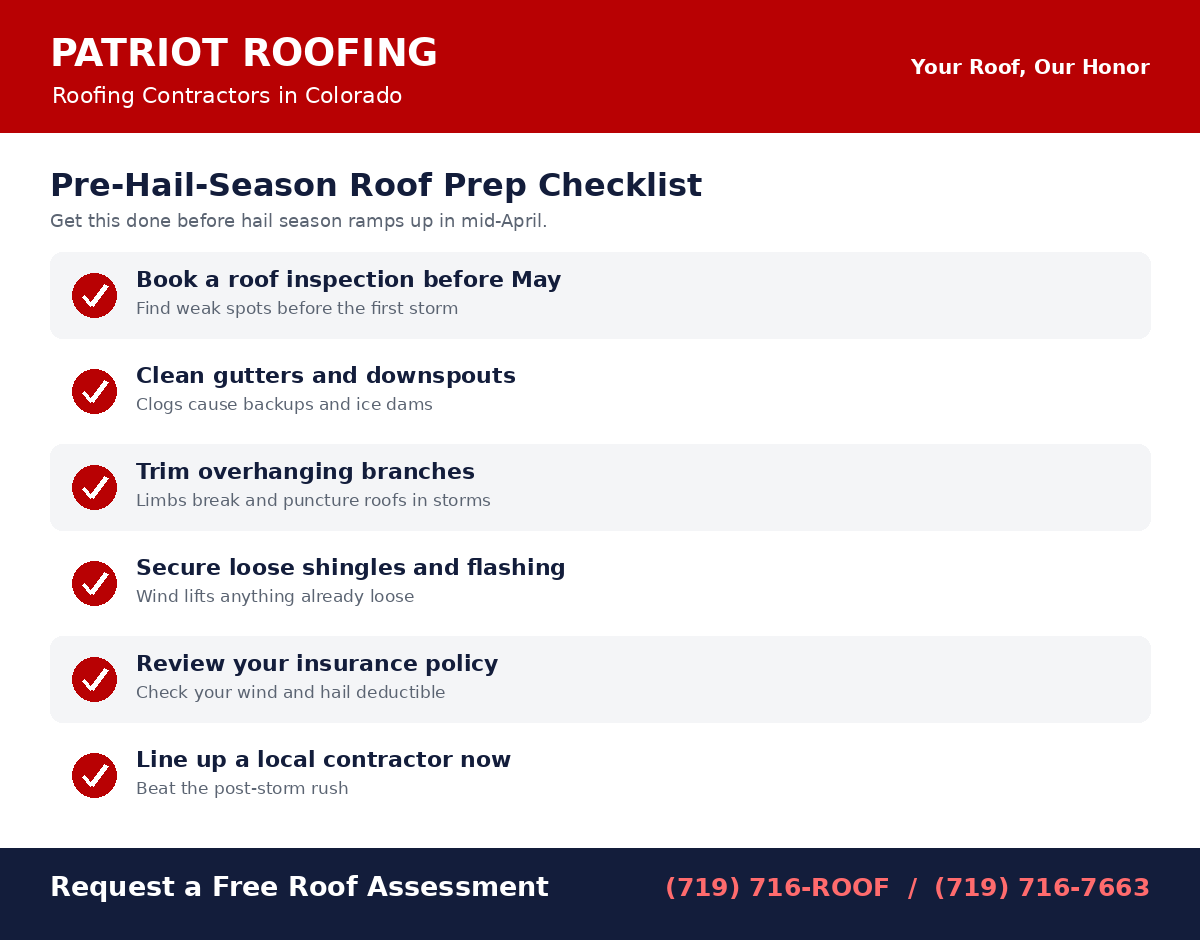
- Book a roof inspection before May, so weak spots are found and fixed first
- Clean your gutters and downspouts, because clogs cause water backups
- Trim overhanging branches that can break and puncture the roof in a storm
- Secure any loose shingles or flashing, since wind lifts whatever is already loose
- Review your insurance policy, especially your wind and hail deductible
- Line up a local contractor now, so you are not starting from scratch after a storm
Let us walk through the ones that matter most.
Start with an inspection
The single best prep step is a professional roof inspection before the season. A roofer gets on the roof, finds loose shingles, worn flashing, failing pipe boots, and any existing damage, and fixes small problems before a storm turns them into big ones. It also gives you a documented baseline of your roof’s condition, which is useful later if you ever need to prove storm damage was new. If you are not sure what to look for yourself, our guides on how do I know if my roof is damaged and how to tell the age of a roof are good starting points.
Clean gutters and trim branches
Gutters and downspouts are part of your roof system. When they clog with leaves and granules, water backs up under the shingles and at the eaves, and in a hard Colorado freeze-thaw that backup turns into ice and rot. Clear them before the wet season. While you are at it, trim back any branches that overhang the roof, because wind-driven limbs are a common cause of puncture damage and broken shingles during a storm.
Review your insurance before you need it
The worst time to learn how your policy works is while you are filing a claim. Before the season, pull out your declarations page and check two things. First, your wind and hail deductible, which in Colorado is often a percentage of your home’s value rather than a flat amount, so it can be larger than you expect. Second, whether you have replacement cost or actual cash value coverage, since that decides how much you get on an older roof. Our insurance claim assistance page explains how we work a claim with you, and if a storm does hit, our step-by-step guide on how to file a hail damage insurance claim in Colorado walks through the process.
Build a contractor relationship now
After a major hailstorm, demand explodes, and out-of-state storm chasers flood the area. If you already have a relationship with a trusted local contractor, you skip the panic and the scams. You know who to call, they know your roof, and you are near the front of the line instead of the back. Building that relationship before the season is one of the most underrated prep moves there is.
The Colorado hail season timeline
Here is how the year tends to unfold, so you know when to do what.
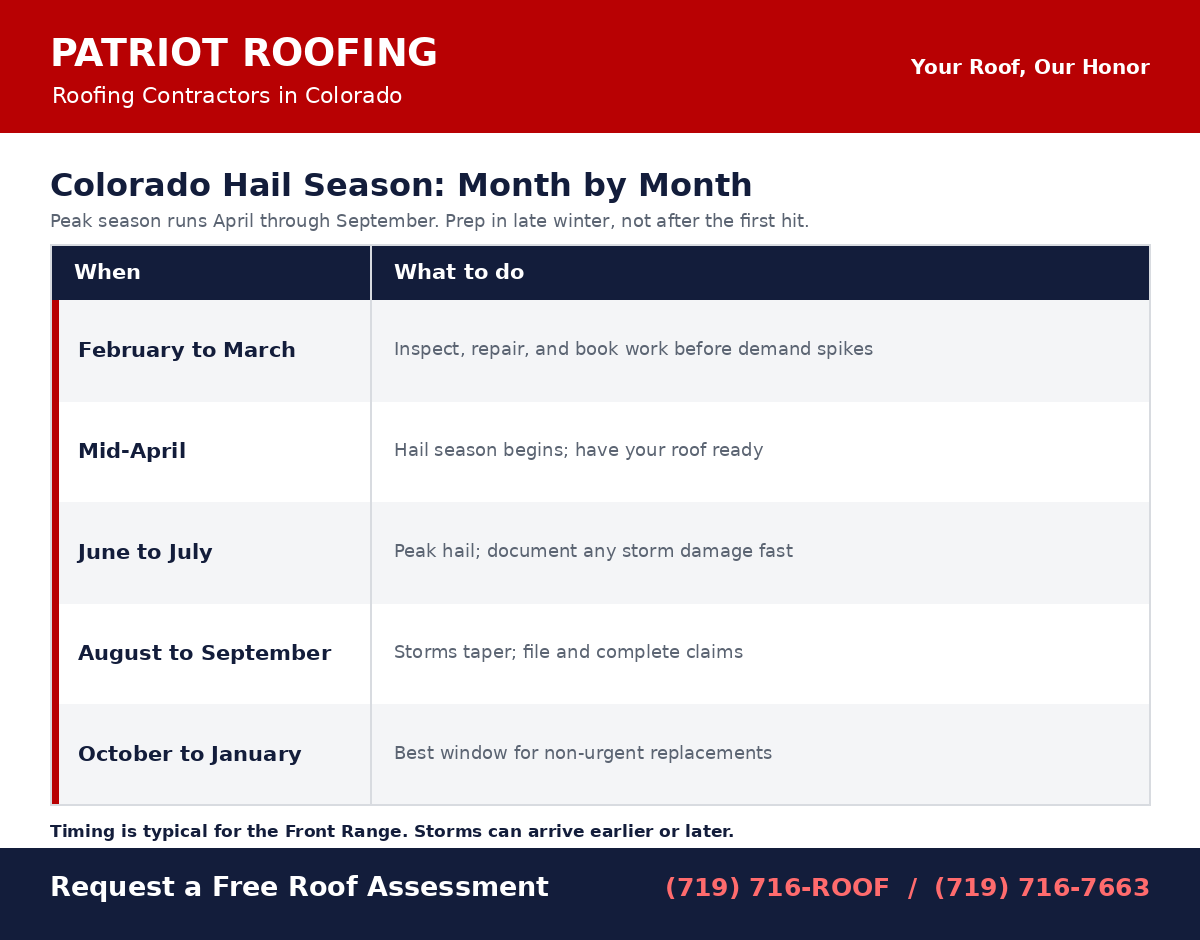
February and March are for inspecting, repairing, and booking any work before demand spikes. By mid-April, hail season is underway, so your roof should already be ready. June and July are the peak, and if you take a hit, document it fast and start the claim. As storms taper in late summer, file and finish claims. And the quieter stretch from October into winter is actually the best window for non-urgent replacements, before the next cycle begins.
If a storm beats you to it
Even a well-prepped roof can take hail damage, and that is not a failure, it is why you carry insurance. If a storm hits, do not climb up yourself. Get a professional inspection, document everything, and see our guide on what does hail damage look like on a roof. If you are weighing a more hail-resistant roof, impact-rated asphalt shingles and metal roofing both stand up far better and can earn an insurance discount. For the honest trade-offs on timing a replacement, see our guides for Colorado Springs and Pueblo.
Get Ahead of the Season
The best time to get your roof checked is before the first storm, not after. We will get on it, find and fix the weak spots, and give you a documented baseline and an honest read on whether it is ready for another Colorado hail season. No pressure, no obligation.
Request a Free Roof Assessment today by calling Patriot Roofing at (719) 716-ROOF, or reach us through our contact page. We serve homeowners across the Colorado Front Range with residential roofing, inspections, and storm damage work. Your Roof, Our Honor.
Frequently Asked Questions
When is hail season in Colorado?
Along the Front Range, hail season runs roughly from mid-April through September, with the heaviest activity often in June and July. Colorado sits inside Hail Alley, one of the most hail-prone regions in the country.
When should I prepare my roof for hail season?
Do your prep in late winter and early spring, roughly February through early April, before the season starts around mid-April. Waiting until hail is in the forecast means every good contractor is already booked.
How do I prepare my roof for hail?
Get a professional inspection and fix weak spots, clean gutters and downspouts, trim overhanging branches, secure loose shingles and flashing, review your insurance policy, and line up a trusted local contractor before the season.
Can you really prevent hail damage?
You cannot stop hail from hitting, but you can make sure the roof is in its best condition to take it and avoid turning small existing problems into big ones. Impact-resistant materials also reduce the odds and severity of damage.
Does cleaning my gutters really matter before hail season?
Yes. Clogged gutters and downspouts cause water to back up under shingles and at the eaves, which leads to leaks and rot, and in freeze-thaw cycles, ice damage. Clearing them before the wet season protects the whole roof edge.
Should I review my insurance before hail season?
Absolutely. Check your wind and hail deductible, which in Colorado is often a percentage of your home’s value, and confirm whether you have replacement cost or actual cash value coverage. Knowing this before a storm prevents nasty surprises.
What is a wind and hail deductible?
It is a separate deductible that applies to wind and hail claims, often set as a percentage of your dwelling coverage, commonly 1 percent to 5 percent, rather than a flat dollar amount. On a higher-value home, that can be several thousand dollars.
Are impact-resistant shingles worth it in Colorado?
For most hail-country homeowners, yes. Class 4 impact-resistant shingles resist hail far better than standard shingles and often earn a premium discount from Colorado insurers, so they can offset part of their own cost over time.
Why should I pick a contractor before a storm hits?
Because after a major storm, demand spikes and out-of-state storm chasers flood the area. Having a trusted local contractor lined up means faster service, no scramble, and far less risk of hiring someone who disappears after the job.
What should I do if my roof is damaged by hail?
Do not climb up yourself. Get a professional inspection, document the damage with photos, review your policy, and start your claim promptly. A local roofer can meet your adjuster on the roof so nothing gets missed.
Request a Free Roof Assessment
Get ahead of the season while the weather is still calm. Request a Free Roof Assessment today by calling Patriot Roofing at (719) 716-ROOF, or reach us through our contact page. Your Roof, Our Honor.