



Roof Underlayment Types Explained for Colorado Homeowners
Most people pick a shingle and never think about what goes underneath it. But the layer between your shingles and the wood deck, called underlayment, is the part that keeps water out when the shingles get breached by hail, wind, or ice. In Colorado, where roofs take a beating from all three, the underlayment you choose matters more than most homeowners realize.
We are Patriot Roofing, a locally owned company with a storefront at 503 N Main St in Pueblo. We install roofs across Southern Colorado and the Front Range, and this guide explains the three main underlayment types, what Colorado code generally requires, and where the peel-and-stick membrane called ice and water shield belongs. This is general information, and roof code is adopted locally here, so confirm the details with your building department or ask us.
What underlayment actually does
Underlayment is a water-resistant sheet rolled out over the roof deck before the shingles go on. According to InterNACHI’s guide to underlayment types, it is a secondary layer of protection: if wind lifts a shingle or hail cracks one, the underlayment is what stops water from reaching the wood. It also shields the deck during installation and helps guard against ice dam damage. As Owens Corning explains in its underlayment overview, local codes generally require it, and most shingle manufacturers require it to keep their warranty valid.
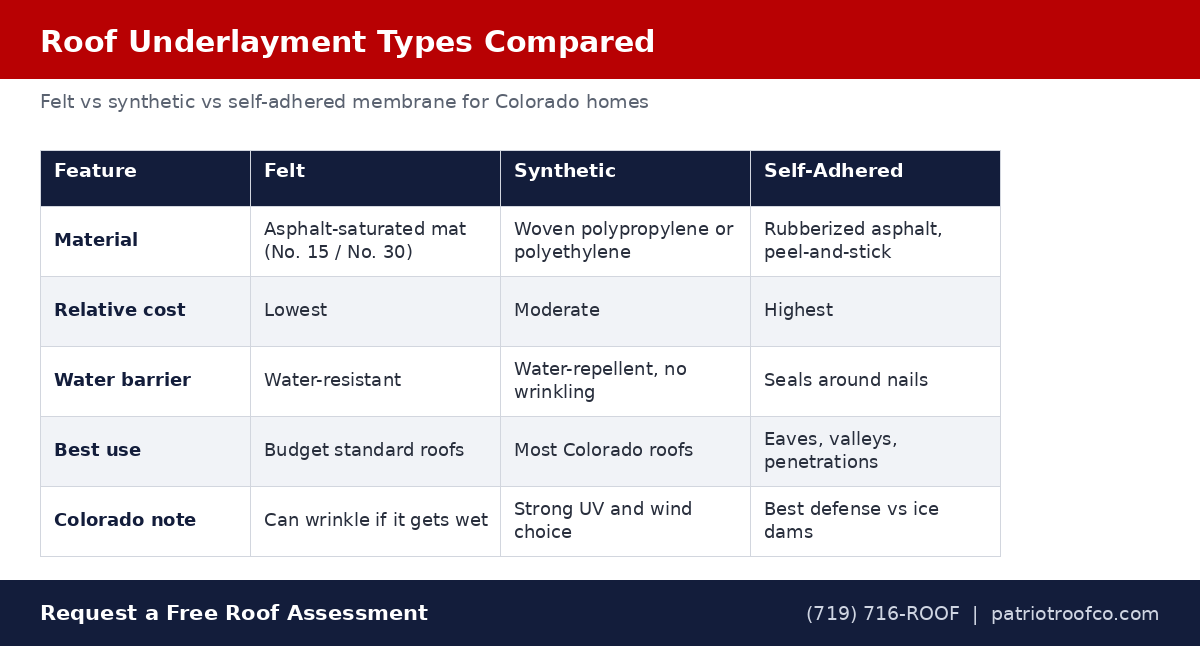
There are three types in common use on Colorado homes. Here is how they compare.
Asphalt-saturated felt
Felt is the traditional choice, often called tar paper. It is a mat soaked in asphalt, sold in two weights: No. 15 and the heavier, tougher No. 30. Felt is water-resistant but not waterproof, and it is the lowest-cost option.
The trade-offs show up in Colorado’s climate. Felt can absorb water and wrinkle if it gets rained on before the shingles go down, and it can dry out and tear under our strong sun and big temperature swings. It still does the job on a straightforward residential roofing project when installed and covered quickly, and many solid asphalt shingle roofs sit on a No. 30 felt base.
Synthetic underlayment
Synthetic underlayment is woven from polypropylene or polyethylene. It is lightweight, much stronger than felt, and it does not absorb water, so it will not wrinkle. It resists tearing in wind, gives crews a safer non-skid surface to walk, and tolerates weeks or months of sun exposure before the shingles go on, which matters when a Colorado storm stretches a job out.
For most of the roofs we install, synthetic is the better base. It holds up to our UV and wind, it stays flat, and it protects the deck longer if the work is delayed. The main catch is that synthetic products are not covered by a single industry standard the way felt is, so quality varies by brand, and it should be fastened with cap nails rather than staples.
Self-adhered membrane (ice and water shield)
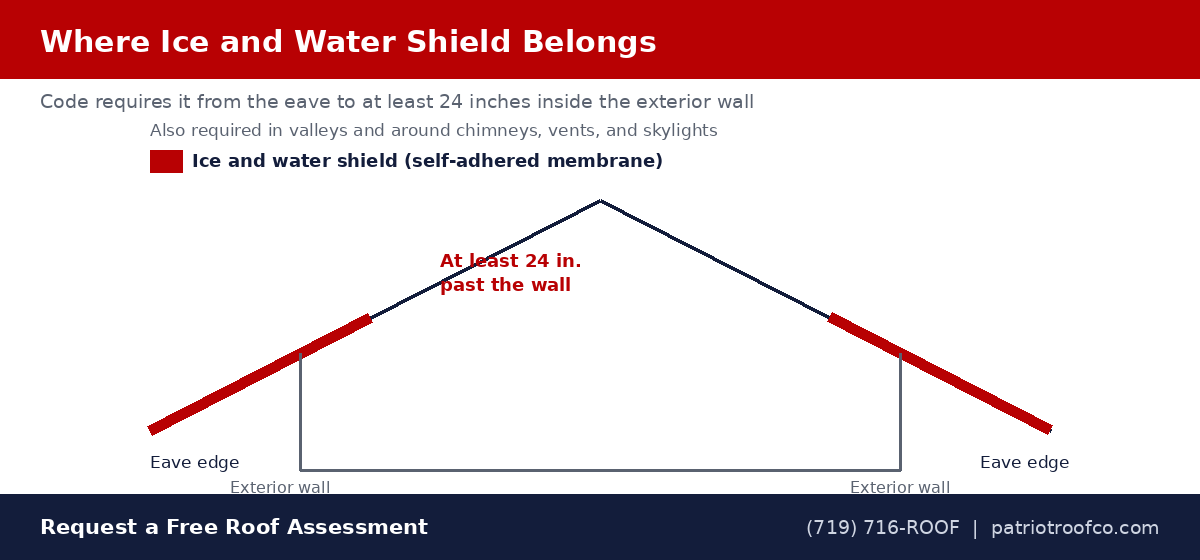
Self-adhered membrane is a rubberized asphalt sheet with a peel-off backing and a sticky underside. Because it bonds directly to the deck, it seals around every nail that goes through it. That self-sealing quality is why it is the go-to for the leak-prone spots on a roof: eaves, valleys, and around chimneys, vents, and skylights.
This is the material most people mean when they say ice and water shield. It is the strongest defense against two Colorado problems: ice dams that back water up under the shingles at the eaves, and wind-driven rain that gets pushed uphill during a storm. It costs more than felt or synthetic, so it is typically used in the high-risk areas rather than across the whole roof, unless local code or your situation calls for more.
What Colorado code requires
Colorado does not have one statewide roof code. Each city and county adopts and amends a version of the International Residential Code, so the exact rules depend on where you live. A couple of baseline points hold across most jurisdictions.
First, the ice barrier rule. Under IRC Section R905.1.2, in areas where ice forms along the eaves and backs water up, a self-adhered ice barrier (or two cemented layers of underlayment) is required from the eave edge to at least 24 inches inside the exterior wall line. In plain terms, the membrane has to reach far enough up the roof to clear the heated part of your house. Many Colorado mountain and foothill jurisdictions amend this to extend coverage further, sometimes up the full eave run or across more of the deck, because our freeze-and-thaw cycles are hard on roofs.
Second, slope affects how many layers you need. Standard shingle underlayment is a single layer on roofs 4:12 and steeper, and a doubled layer on lower slopes down to 2:12. Below that, you are into a different roofing system entirely.
Because the specifics vary, confirm with your local building department. In the Pikes Peak region, that is the Pikes Peak Regional Building Department, which handles permits and inspections for El Paso County and Colorado Springs. Pueblo, Fremont County, and the smaller towns each run their own. A licensed contractor pulls the permit and builds to the adopted code for you.
Get the Layer Under Your Shingles Right
Re-roofing soon and not sure what belongs under your shingles? We will walk your roof, check the deck and the leak-prone areas, and recommend the underlayment that fits your slope, your budget, and your local code. No pressure, no obligation.
Request a Free Roof Assessment today by calling Patriot Roofing at (719) 716-ROOF, or reach us through our contact page. We serve Pueblo, Colorado Springs, and the wider Colorado Front Range.
Why underlayment matters more in Colorado
In a mild climate, underlayment is a backup you rarely test. In Colorado, you test it every season. Hail cracks shingles and exposes what is beneath them. Spring and fall winds lift shingle edges. Winter builds ice dams at the eaves, and the spring melt looks for any gap. The underlayment is the layer standing between all of that and your plywood.
That is also why underlayment questions come up most often after a storm. If you have had hail or wind and you are seeing stains inside, the issue may be a breach that reached the deck. Our guides on what to do when a roof leaks after a hail storm and how to prepare your roof for Colorado hail season go deeper, and storm damage roof repair is where we start when the damage is already done.
Good attic airflow works alongside your underlayment to keep the deck dry and reduce ice dams, which is why we often pair the two. See our guide to attic ventilation for Colorado roofs for that side of the system. Colorado is also encouraging stronger roof systems through new resilience programs, including the grant effort the state set up under SB26-155, so a quality build pays off in more ways than one.
Frequently Asked Questions
What is roof underlayment?
Roof underlayment is a water-resistant sheet installed over the wood roof deck before the shingles. It is a secondary barrier that keeps water out if a shingle is cracked, lifted, or blown off, and it protects the deck during installation.
What are the three main types of roof underlayment?
The three common types are asphalt-saturated felt, synthetic underlayment, and self-adhered membrane (ice and water shield). Felt is the traditional low-cost option, synthetic is lighter and tougher, and self-adhered seals around fasteners at leak-prone areas.
Is synthetic underlayment better than felt?
For most Colorado roofs, synthetic has the edge. It is stronger, will not wrinkle or absorb water, resists tearing in wind, and tolerates sun exposure longer than felt. Felt costs less and still works when installed and covered promptly.
What is ice and water shield?
Ice and water shield is a self-adhered rubberized membrane that sticks to the roof deck and seals around nails. It is used at eaves, valleys, and around chimneys, vents, and skylights to stop leaks from ice dams and wind-driven rain.
Does Colorado code require ice and water shield?
In most Colorado jurisdictions, yes, at the eaves. The International Residential Code requires an ice barrier from the eave edge to at least 24 inches inside the exterior wall line in areas prone to ice dams. Many mountain and foothill towns extend that further by local amendment.
How far up the roof does ice and water shield need to go?
The code minimum is from the eave edge to at least 24 inches past the inside of the exterior wall. On a home with wide eaves or in a high-amendment mountain town, that distance is larger, so confirm the figure with your local building department.
Can you use felt underlayment in Colorado?
Yes. Felt, especially the heavier No. 30, is code-compliant for standard shingle roofs and is still widely used. The main concerns in our climate are wrinkling if it gets wet before cover and drying out under strong UV over time.
Do I need underlayment under a metal roof?
Yes. Metal roofs use underlayment too, and high-temperature self-adhered membranes are made specifically for them because metal gets hot. The right underlayment supports the warranty and protects the deck, so it is part of any quality metal roof install.
Does underlayment affect my shingle warranty?
Often, yes. Many shingle manufacturers require underlayment, and some require specific accessory products installed as a system, to keep the full warranty in force. Using the wrong underlayment or skipping it can reduce or void coverage.
How much of the roof should get self-adhered membrane?
At a minimum, the eaves to the code-required distance, plus the valleys and penetrations. Some homeowners choose to cover more of the deck for extra protection, and some mountain jurisdictions require it. A contractor can map the right coverage for your roof and local code.
Request a Free Roof Assessment
Not sure your current roof has the right layers underneath? Let us take a look. Request a Free Roof Assessment today by calling Patriot Roofing at (719) 716-ROOF, or reach us through our contact page. We serve Pueblo, Colorado Springs, and the Front Range with residential roofing, metal roofing, roof inspections, and flexible roof financing. Your Roof, Our Honor.